
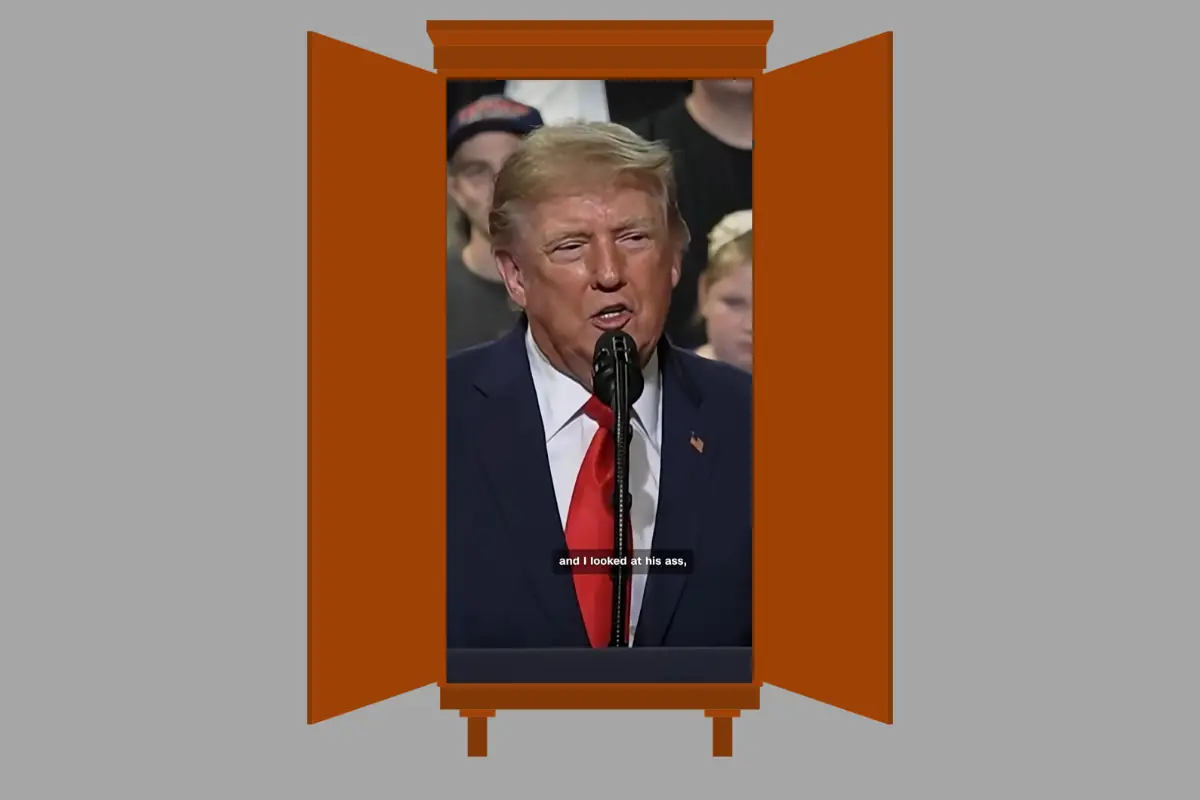
For six years now, Donald Trump has been arguably the most famous Gemini on Earth. Gemini is a sign symbolized by twins, characterized by traits such as curiosity, quick wit, and myriad faces. Among Trump’s most urgent and revealing curiosities in recent times has been the physiques of male GOP candidates leading up to the 2026 midterm elections, particularly Ohio senator Jon Husted.
The “Beautiful” Men That Trump Is “Still Recovering” From
His close examination of Husted’s physical features read as something out of gay erotica, say, a bygone entry on Nifty. “I examined his ass. And then I looked at his shoulders. I looked at his feet. I looked at his hand. I looked at his jawline,” he said out loud of Husted, to a crowd of thousands. “I then patted him on the shoulder, and it was like a piece of steel. I’m still recovering.”
You be the judge.
He didn’t stop there. A few other GOP candidates went through Trump’s physical screening: Georgia gubernatorial candidate Rick Jackson (“very handsome, distinguished, beautiful-looking”), Kentucky House candidate Ed Gallrein (“beautiful”), and Georgia Senate nominee Mike Collins (“a good-looking man … he’s all man”).
While, of course, a man acknowledging the beauty of another man might also mean that he’s comfortable with his sexuality, Trump indeed has a storied fascination with the male physique to the point of voyeuristic obsession. Coming from a party that frequently demonizes LGBTQ Americans, whose administration has by and large enacted the abominable Project 2025, this behavior comes off not only hypocritical but also appalling.
Homosociality or homosexuality?
In 1976, Jean Lipman-Blumen birthed the term “homosociality” and described it as “nonsexual attractions held by men, or women, for members of their own sex.” Nearly a decade later, Eve Kosofsky Sedgwick further expounded on the term, specifically on how “the emerging pattern of male friendship, mentorship, entitlement, rivalry, and hetero- and homosexuality was in an intimate and shifting relation to class […] and that no element of that pattern can be understood outside of its relation to women and the gender system as a whole.”
For a power-hungry individual like Trump, homosociality is par for the course; see his Access Hollywood tape with Billy Bush, that of the “grab ‘em by the pussy” infamy. However, Sedgwick also draws a distinction between homosociality and homosexuality, positing that the former may be characterized “by intense homophobia, fear and hatred of homosexuality.” A prime example is his disparaging pre-presidency tweet to Arianna Huffington; it sheds light on not only how he views women (a punching bag, or a means to an end – in his case, typically offhand misogyny) but also homosexuality at large, how its validity hinges upon its practitioners.
“Closetocracy”: Lust For Men, Power, or Both?
It is glaringly palpable the men Trump often gushes over are older and White. In his own words, he’s specifically not a fan of “young, handsome guys.” I wager that this sentiment derives from his deep-rooted insecurities — his own mother allegedly called him an idiot and a disaster for politics, a factual prophecy — particularly when it came to more accomplished or powerful men, who, as per his niece Mary Trump’s retelling, were often subject to casual dehumanization. As the holder of the highest office in America, he most likely feels as if he wields power over these older White men running for office at ranks lower than his. As such, all his objectifying antics, be it for men or women, boil down to nothing but power play.
Here’s where the line between homosociality and homosexuality becomes blurry. While Trump, without a doubt, has used homosociality as a tactic to work his way up the socio-economic and political ladders, his frequent flirtation with homosexuality smacks as a convoluted potpourri of low self-esteem, toxic masculinity, internalized homophobia, power-hungry desires, and good ol’ White Supremacy. This absolutely tracks with the politics that permeates the very party that Trump represents.
In a scathing takedown of closeted gay Republicans, Hunter Biden coined the term “closetocracy,” a “gay mafia” theory that postulates a network of closeted, anti-LGBTQ+ politicians whose public policy positions conflict with their private lives. “I believe that internal conflict creates so much vitriol inside a person that they take it out on the rest of the world,” said Biden. “And so what they do is their whole lives they’ve been closeted, and so you have this […] blackened heart by the fact that you can’t be who you wanna be, and so you take it out on everybody else.”
Perhaps most puzzlingly, Trump was not always so vitriolic when it came to LGBTQ+ rights, particularly leading up to his first term; despite expressing opposition to same-sex marriage, he also boldly stated that “there can be no discrimination against gays.” During his second term, however, things sharply nosedived, particularly with regard to trans rights. The Trump administration went on to revoke Biden-era executive orders that prohibited discrimination based on sexual orientation and gender identity across federal agencies, issued directives recognizing only a male-and-female gender binary, and restricted transgender participation and medical care in various federal programs.
This, too, is Trump’s twisted power play. Equal parts contrarian and populist, he would employ all means seen possible and deemed necessary to exert an appearance of power, which, as of late, seem to consist of three things: ambition, esthetics, and asses.
“Trump’s homoerotic, horn-dog vibe is both a genuine expression of self and a strategy to drum up support from the only fans he has left — the ones who hang on to his every word and think he is the greatest entertainer on Earth,” succinctly summed up Jack Crosbie for Rolling Stone. So caught up in the snare of his self-perceived grandeur, he seemed to genuinely believe that his homosexual shenanigans made him more interesting to voters. Americans, fed up by rising prices and an increasingly tougher job market, promptly and rightfully responded with an out-and-out “blue wave” come the 2026 midterms.
You’re Not Gay If You’re Powerful: Lessons From Roy Cohn
To understand Trump’s bizarre, insidious dealings with homosociality and homosexuality, perhaps it’s best to trace back his relationship with Roy Cohn. Possibly the most influential figure in Trump’s life, the disgraced lawyer, prosecutor, and conservative political activist taught Trump all there was to know about managing and dominating situations and people. Fascinatingly, Cohn was a closeted gay man — he famously denied having contracted AIDS despite later on dying from AIDS — who “ruthlessly” went after gay civil servants in the State Department via the Lavender Scare.
The word “gay” is perhaps to be loosely used here; Cohn associate Roger Stone insisted that Cohn was “not gay … He was a man who liked having sex with men. Gays were weak, effeminate. […] He was interested in power and access.” Couple this with the depiction of Cohn in Angels in America, who strictly defined his identity through political clout and influence, and Cohn’s well-storied core doctrine of never settle, never surrender, counterattack, and claim victory, then we are beginning to scratch the surface on the makings of Trump and Trumpism.
In their book Bad Gays: A Homosexual History, Huw Lemmey and Ben Miller evoke the idea of “failure of homosexuality as an identity and a political project,” arranged on three primary axes, most notably its separation from and fear of gender non-conformity. Of Cohn, they recounted his unhappy upbringing (aloof and cold father; obsessive and cruel mother), which otherwise instilled in him the importance of law, money, and politics as interconnected tools for wielding power thanks to the social standing of his parents.
“To not see that Roy was gay, you had to choose not to see it — which is what his network of conservative clients, politicians, and businessmen chose to do,” wrote Lemmey and Miller. “Keeping his side of the bargain, Cohn simply refused to acknowledge what was clear to everyone, and went to great lengths to maintain the fiction.” If this sounds familiar, it’s—ironically—straight out of the anti-LGBTQ+ Republicans playbook.
Yes, all these (often older) White men are products of their time when there was an abundance of negative stigma attached to homosexuality. As such, any association with it is shameful — disgraceful, even.
“Homosexuals are men who know nobody and who nobody knows. Who have zero clout,” goes a line in Angels in America’s take on Cohn. “I have clout. A lot.” The play’s Cohn goes on to deliver his thesis statement — deluded, but admirable in its staunch belief in its own delusion — of how he “is not a homosexual. Roy Cohn is a heterosexual man, […], who fucks around with guys.” Perhaps, just perhaps, this is also how Trump perceives himself, whether or not he physically fucks around with guys.
Cohn’s tale, in a way, also reminded me of Rock Hudson. In the thick of the AIDS epidemic, the Old Hollywood heartthrob was clandestinely seeking experimental treatment in Paris for his AIDS diagnosis, at that point unavailable in America. Denied due to his citizenship status, his publicist wrote a personal letter to the Reagans—supposedly Hudson’s close, long-standing friends—demanding a leeway. The Reagans refused and Hudson became the first high-profile casualty of the disease. As it turns out, no amount of personal correspondence and bootlicking (cough Nicki Minaj cough) guarantees anyone’s standing in the face of rampant conservatism, in the throes of fascism.
***
Sometimes I wonder if the key to a healthier society — or if we’re being earnest, world peace — is the destigmatization of male-on-male intimacy. I have waxed poetic on the correlation between repressed bisexuality and the male loneliness epidemic. On the flip side, perhaps the less dissected side effect of repressed bisexuality is bisexual, or indeed gay, men seeking power by ruining the lives of others, especially the very people they are supposedly a part of, out of long-held fear of living out the side of themselves they’re hell-bent on repressing.
The likes of Trump might wield all the power in the world, especially as the leader of the free world. But at what cost? It might take Trump’s eventual demise before these conversations can be had openly by men in the Western world.