
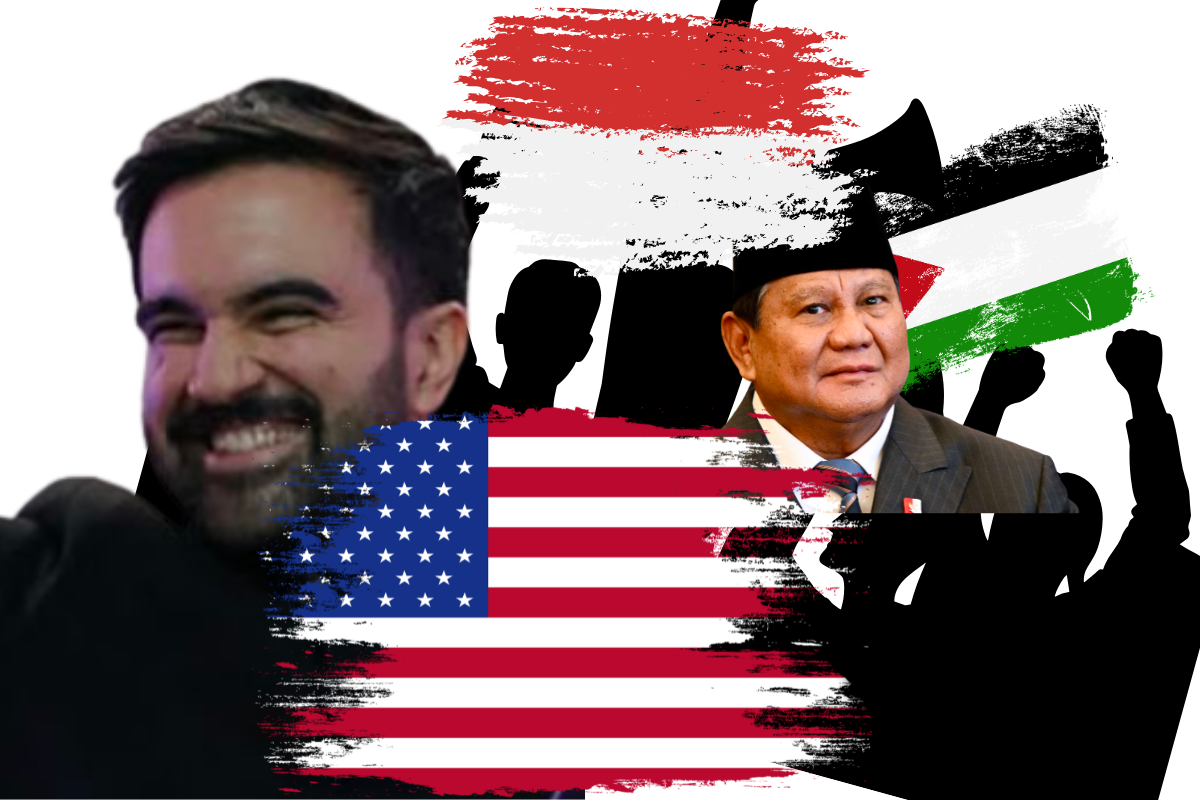
Indonesia’s Confused Investment in Zohran Mamdani and US Politics
As an Indonesian in America, I have been mistaken for, among other things, Filipino (understandable, close enough), Chinese (of course), Korean (what was that about?), even Latino (seriously, where did that come from?). Japanese is probably somewhere on the horizon at this point. The perceived lack of historical ties between Indonesia and America, coupled with Americans’ well-documented ethnocentrism and general lack of interest in the rest of the world (a concerted, institutionalized effort, as it were), means that the average American simply has no idea where Indonesia is let alone a fleeting knowledge of it.
In reality, the Indonesia-America ties run deep (a United States of Indonesia even existed at one point), most infamously exemplified in the CIA-backed 1965-66 mass killings. This would give birth to “The Jakarta Method,” later covered and dissected extensively in Vincent Bevins’ excellent book of the same name. Jakarta, Indonesia’s capital and now the largest city in the world, is also where Barack Obama spent a few years of his childhood, whose 2010 state visit doubled as a homecoming, where he delivered parts of his speech in the Indonesian language. He even has a half-Indonesian step-sister. No other president from any country shares this type of connection with the Equatorial Emerald.
All this and Indonesia remains barely a blip in Americans’ radar. You could point to the fact that there simply aren’t a lot of Indonesians in America, despite Indonesia being the fourth most populated country in the world (right below America!). Uniquely multiethnic, with approximately 1,300 ethnic groups across a sprawl of at least 17,500 islands, this means that there’s no singular Indonesian identity or culture either. It’s worth taking into consideration, too, that the most prominent Indonesians in America are Chinese-Indonesians, nearly all of whom are Christians.
And that brings us to Zohran Mamdani. It’s no brainer that a Muslim elected to the highest office in the so-called capital of the world would be of high interest to the country with the world’s largest Muslim population and a well-storied predilection for colonial mentality, the effects of which continue to ripple well into the present day.
Indonesian vs. American Identity Politics: Pick a Struggle
Republika — essentially Indonesia’s answer to Fox News with a Muslim slant — feverishly ran news articles on Mamdani leading up, during, and after his mayoral triumph, never once failing to highlight his Muslim identity (“Muslim Candidate Zohran Mamdani Wins New York City Mayoral Race” goes one of its headlines). Upon his win, the publication issued a boldly titled video essay: “Palestine’s Triumph in the Heart of America.”
But here’s the catch: the average Indonesian’s present-day pro-Palestine proclivity is largely rooted in Muslim solidarity rather than a clean-cut stance against colonization as per Indonesia’s 1945 constitution (Palestine was the first country to acknowledge Indonesia’s sovereignty in 1944). This is akin to the average American’s penchant for conflating a pro-Palestine stance with antisemitism, an abused buzzword that, of course, comes with undercurrents of anti-Islam and a casual omission of the fact that not only is Palestine home to a population of Jews and Christians, Palestinian Christians are some of the original Christians. Ultimately, as per my first-hand experience and observation, the Palestinian cause has some way to go before being triumphant in America.
If anything, anti-Islam in America and antisemitism in Indonesia are two sides of the same coin: both sentiments reduce the complexities of human beings to belief systems, tropes and stereotypes, misguided conflations, and lazy generalizations. They make no room for context or deeper understanding of lived realities; as such, the Israeli occupation in Palestine is simply whittled down to Judaism versus Islam, no more, no less. The public discourse predictably resorts to whataboutism: what about LGBTIQ people in Gaza? Can you be gay in Gaza? Well, what if we actually just let them exist peacefully in their own land? What about LGBTIQ people in Israel anyway? Or in America, for that matter?
Further inquiries arise: how come a Muslim like Mamdani showed up in gay clubs during his campaign trail? Isn’t that against his religious belief? To quote journalist Glenn Greenwald: “At some point, […] you are going to have to decide on one caricature or the other: whether Zohran is some far-left, communist, pro-trans radical, or whether he wants to impose Sharia Law on everyone and throw gay people off of roofs.” And that’s the keyword: caricature, not character.
If embracing LGBTIQ folks and causes is the ultimate marker of progressivism, it’s baffling that a large faction of society is endlessly preoccupied with his Muslim-ness, desperately attempting to catch loopholes in his character and fear-mongering the masses by resuscitating 9/11 hysteria as if he was personally responsible for the tragedy. And that’s on post-9/11 indoctrination and post-Trump mass psychosis.
In actuality, Mamdani’s pro-LGBTIQ stance would not fly well in a queerphobic country like Indonesia. On top of this, that he is a Shia Muslim — as opposed to the Sunni Muslims that make up 99% of Indonesian Muslims — is largely overlooked and underreported in Indonesian media.
If Mamdani were Indonesian, trivial things such as how his wife is not in hijab, how they are a childfree couple or how he is the offspring of an interfaith couple would be endlessly scrutinized — alas, the Jakarta City Hall would have been far-fetched for him. As fate would have it, he’s a Muslim American and as a Muslim-majority nation, most Indonesians are just elated to see one of their own, even in the supposed absence of historical and national ties, make it in American politics … in New York City. Cue the Allahu Akbar chants.
And that, in a nutshell, is the gist of Indonesian identity politics, vacuous and vicarious in the same breath.
More Than a Muslim Politician: Lessons For Indonesia From Mamdani’s Campaign
Just like in America, Mamdani’s campaign trail and his resulting triumph served as a glimmer of hope in an increasingly fractured nation. Indonesia similarly elected a highly incompetent president in 2024 – his third attempt, excluding a 2009 attempt at the veep position – and an even more incompetent nepo baby (historically a key feature in Indonesian politics) of a vice president. Unsurprisingly, Prabowo Subianto fell short of the promises made during his lousy-yet-beloved, AI-assisted campaign, announcing fiscal spending cuts at the onset of his presidency, ushering in an era of further economic and political frustration.
And then the steep salary increase for House of Representatives members was announced shortly before Independence Day, at the height of rising costs and collapsing job market. This increase meant that members of the House would be granted a take-out pay of up to $6,000 per month; monthly income in Indonesia averages at $300. This proved to be the final straw for dejected and exploited Indonesians: a week later, nationwide protests, marked with police brutality, military intervention, and a number of deaths, erupted. It marked the largest mass demonstration the country had seen since 1998, which eventually ended the New Order regime of Suharto, Subianto’s former father-in-law. His next moves? Media blackout and, of course, making alliance with Trump, preceded by a nod from Benjamin Netanyahu.
“If we want our own versions of Zohran Mamdani, the system will need to change first, full stop,” remarks Najwa Shihab, Indonesia’s premier political journalist. “Even with a lack of office experience, if you have fervent passion and strong desire to respond to the needs of your constituents as well as the ability to mobilize young voters and disenfranchised members of the society, it does go a long way, more so with the help of technological savvy. There are leaders in Indonesia that meet these requirements, but until there’s a shift in the system, unless we have the revised Election Law go into effect, they will continue to lose to political elites and regurgitations of the oligarchy.”
While listing off Mamdani’s unusual credentials for an American politician (young, non-White, immigrant, democratic socialist, Muslim, pro-Palestine), Shihab proceeds to point out the success of his grassroots campaign, which, in her opinion, blended wit, substance, and relatability to powerful effect. “His campaign directly addressed the day-to-day concerns of New Yorkers, and the simple yet impactful way that he delivered his mayoral visions proved to be his calling card. It’s why we’re still talking about him to this day,” she observes.
Furthermore, Shihab draws parallels between New York City and Jakarta as major cities where living costs are increasingly disproportionate to minimum wages, driving more and more people out of them. “Indonesian politicians could learn a thing or two from him zeroing in on affordable housing, free transportation, easy access to childcare, and food security. These are very relatable and relevant issues for Indonesian constituents, especially in Jakarta,” she observes.
However, Shihab also ponders the electability of a Mamdani-like figure in Indonesia given the myriad of political parties and how the electoral process is set up. “Indonesian constituents have yet to develop the habit of making small donations for a campaign. It also helps that America has a more transparent donation system,” she notes, and in the case of Mamdani’s campaign, she does make a correct point. In addition, she highlights the long-standing issue of popularity, financial backing, or nepotism greatly influencing candidate nominations. “This means that it’s systematically more difficult for politicians who genuinely care about people backed by actual skills and fresh ideas to flourish. And even more difficult to have someone like Mamdani, who ended up toppling a political dynasty,” she concludes.
Political dynasty is, of course, the name of the game in Indonesian politics. Joko Widodo, Indonesia’s seventh president and first to fully hail from a civilian background, might have initially been lauded as Indonesia’s “new hope” … only to be backed by a dynasty and later create his own dynasty. (Fascinatingly, there’s also a parallel between Mamdani’s hands-on approach and Widodo’s blusukan method, popularized during his stint as the Jakarta governor in the early 2010s.)
As Shihab underscores, Indonesian politics is quite literally archaic, rife with hierarchical mentality and Islamic populism; America, flaws and all, is a place where Trumpism and Mamdani’s New York can exist. Current war on immigrants aside, Mamdani is the living embodiment of, ironically, Reagan’s famous last words. I suppose New York City is the concrete jungle where dreams are made of.
My personal source of amusement, though, is Mamdani being born merely 11 days after me. Only seven years into being a US citizen, he now runs the most popular city in America and the world. Yes, he lucked out by having an esteemed academic for a father and a revered feminist filmmaker for a mother, but seeing his trajectory did incite something in me: while I harbor no political aspiration whatsoever, bearing witness to a fellow immigrant of color and of the same age go this far in America, and at a very public level to boot, has made me feel like I, too, could make something for myself in this country. It has given me the hope to one day be authentically seen, understood, and rewarded in my field of choice; it is this hope that keeps me going even – perhaps especially – in Trump’s America.
***
When I used to live in Dothan, Alabama, I attended a No Kings protest where an older gentleman with a T-shirt that said “RESIST” handed me the pocketbook version of the Constitution. “Here, have this,” he said, holding my hand. “This used to mean something.” It touched me profoundly. He didn’t assume I was just some passerby, a foreigner, or worse, an alien. He probably assumed I was another American invested in the cause, concerned about the shape that America was in. Which I was. Which I have always been. Despite everything, the rest of the world still sees America as the land of opportunity and freedom; all the immigrants, fellow Indonesians or otherwise, that I have met along the way in my American journey will proclaim as much. And it is our imperative duty, now more than ever, to protect this freedom.